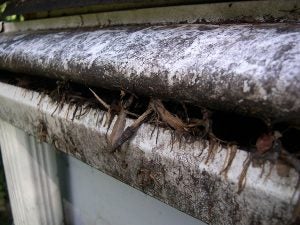
Tile roofs and gutters in the San Ramon Valley: Concrete tile is not a walking surface, so gutter work on a tile home should happen from ladders with standoffs, not from the roof. Tile also funnels debris to a few points and sheds a gritty sludge that has to be dug out, and the eave hides a bird stop and anti-ponding detail that careless ladder work can crush. Hire a crew that works from the edge, never DIY a two-story tile roofline, and ask exactly how any guard will attach before anyone starts. Call (925) 905-9555 or get a free quote online.
5 inch or 6 inch gutters in the Tri-Valley: If a clean gutter sheets water over the front edge in a December storm, that is a capacity problem, not a debris problem. A 6 inch gutter carries roughly 40 percent more water than a 5 inch, with larger downspouts to match, and it belongs on runs over 40 feet that cannot take a second downspout, any run over 60 feet, lower gutters catching an upper roof, and inside valleys that overflow. If your run is under 40 feet, has a downspout, takes no upper roof and does not overflow in a real storm, 5 inch is fine. Call (925) 905-9555 or get a free quote online.
Fire season and gutters in the Tri-Valley: From September through November, Diablo winds pack the driest debris of the year into gutters right when ember risk peaks, and UC ANR calls debris in gutters one of the greatest fire hazards for a building. Metal gutters beat vinyl, which drops burning material to the ground, but a full metal gutter still holds flame at the roof edge. So the priority order is: keep the gutters clear through fire season, replace vinyl with metal, pull out any foam inserts, and use only all-metal guards. Call (925) 905-9555 or get a free quote online.
Getting a San Ramon home rain-ready: Treat the first real storm, which usually lands between mid-October and mid-November, as your deadline and work backward from it. Clear the trough and the downspout openings, flush every downspout until water comes out the bottom, follow each outlet to where the water lands, and read last winter’s streaks, sags and soft fascia for what needs repair. Book in September if you want your pick of dates, because the whole valley calls the same week the forecast first mentions rain. Call (925) 905-9555 or get a free quote online.
How often to clean gutters in the San Ramon Valley: Twice a year for most homes: once in late April or May, after the oak catkins and coast live oak leaf drop finish, and once in late fall, after the valley oaks are bare. The valley has two separate debris seasons because evergreen oaks, redwoods and pines shed in spring and summer while valley oaks, sycamores and sweetgums drop in fall. Homes with redwoods, pines or heavy canopy over the roof usually want a third visit in late summer, when needle drop peaks. Call (925) 905-9555 or get a free quote online.