
Category: Gutter cleaning

A Year of Gutter Care in the San Ramon Valley: A Season-by-Season Guide

How often should you clean gutters in California? In the San Ramon Valley, twice a year is the honest answer: once in late spring and once in late fall. That surprises people who moved here from somewhere with a proper autumn, because the assumption is that leaves fall once and then you’re done until next October. Our trees don’t work that way. The Tri-Valley has two distinct debris seasons, and a gutter that only gets cleaned in November spends the whole spring quietly filling back up.

This is the long version of that answer: what actually lands in your gutters, when, and what’s worth doing about it in each season.

Why the Tri-Valley Genuinely Has Two Debris Seasons

Most gutter maintenance advice is written for the Northeast. Deciduous trees drop everything in a six-week window, you clean up after, winter arrives, done.

Here, the calendar is split. Our evergreens (coast live oak, redwood, pine) shed while they grow, dropping old foliage in spring and summer rather than saving it for fall. Our deciduous trees, meaning valley oak, sycamore, and the sweetgums and liquidambars planted through Dougherty Valley and Gale Ranch, do the traditional autumn drop. Two different groups of trees, two different schedules, and most yards in the valley have both.

Add the timing of our rain. We get nearly all of our annual rainfall between November and April, which means the material that lands in spring sits in a warm dry gutter for six months and compacts into something closer to soil than debris. By the time the first real storm arrives, it isn’t a pile of leaves that water can push through. It’s a dam.

Spring: March Through May, the Season Nobody Expects

This is the surprise. Coast live oak is evergreen, so people assume it never makes a mess. It does. It just does it in spring, dropping last year’s leaves as the new ones push out. Somewhere around March, a mature live oak will carpet everything under it with small, stiff, curled leaves that are almost purpose-built to wedge into a downspout opening.

At the same time, oaks throw catkins, the dangling, worm-like pollen strands that cover cars and patio furniture in March and April. They’re light and stringy, they mat together when they get damp, and they slip through screens that stop bigger leaves. California sycamores add their own contribution: seed balls that break apart into a fine brown fuzz that travels on the wind and clogs anything with a filter.

Spring Checklist:

  • Clean or schedule a cleaning after the catkin drop finishes. Late April into May is the sweet spot
  • Flush downspouts with a hose and confirm water is actually coming out the bottom
  • Clear matted catkins off the top of any gutter guards; screens can stay covered even when the trough underneath is clean
  • Check that downspout extensions still direct water away from the foundation after winter storms

Summer: June Through August, Dry but Not Quiet

Summer is the valley’s inspection season. There’s no rain to reveal problems, which is exactly why it’s the best time to find them before the rain does.

It’s also when the needles peak. Redwoods and pines shed year-round, but the heavy flush comes in the heat of late summer, and inland San Ramon runs considerably hotter than the coastal range redwoods actually want, so trees here shed more than their Santa Cruz cousins do. If you have a redwood anywhere near your roofline, you have a year-round, low-grade needle problem that spikes in August and September.

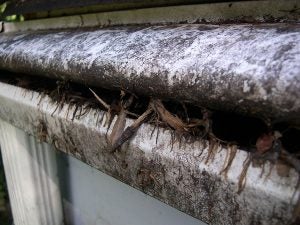
Here’s the part worth knowing: fine redwood needles pass straight through coarse gutter screens. Standard mesh and slotted screens are sized to stop leaves. Needles are thinner than the openings, so they drop right through, settle into the trough, and pack down where you can’t see them. Plenty of homeowners with guards installed are genuinely surprised to learn their gutters are full. If redwoods are your main issue, the guard system matters more than whether you have one at all. Micro-mesh guards with a fine enough weave are the ones that handle needles.

Summer Checklist:

  • Walk the perimeter and look for sagging sections, separated seams, or gutters pulling away from the fascia
  • Check hangers and spikes, since summer heat cycles loosen fasteners
  • Look for peeling sealant at inside and outside corners, the most common leak point
  • Confirm gutters still pitch toward the downspouts; standing water leaves a visible tide line
  • Book any repairs now, while the schedule is open and the roof is dry

Fall: September Through November, the Season Everyone Knows

Now the deciduous trees take their turn. Valley oaks drop leaves and acorns from October into November, and acorns are their own category of problem. They don’t decompose, they don’t flush, and they roll straight into downspout openings and sit there. Sweetgum balls do the same thing. Add a heavy needle carryover from summer and this is the biggest volume of the year.

The timing matters more than the thoroughness. Clean too early and you’ll do it again; clean too late and the first storm finds a full gutter. The window in the San Ramon Valley is roughly mid-November to mid-December, after the valley oaks have finished and before the rain gets serious. That’s the single most important gutter cleaning of the year.

Fall Checklist

  • Schedule the main cleaning for the second half of November
  • Clear acorns and seed balls out of downspout openings specifically, not just the trough
  • Test every downspout with a hose after cleaning
  • Check that water leaving the downspouts is heading away from the house and not pooling near the slab
  • Look at the roof valleys while you’re up there, since they funnel debris straight into the gutters

Winter: December Through February, Watch It Work

Winter maintenance in the Tri-Valley is mostly observation, and the best time to do it is during an actual storm. Five minutes at the window while it’s raining hard will tell you more than an hour on a ladder in July.

Winter Checklist:

  • During a real downpour, look for water sheeting over the front edge of the gutter, which means a clog or an undersized downspout
  • Check for drips at the corners and end caps
  • Watch where the downspouts discharge; soil erosion or a puddle against the foundation means the extension isn’t long enough
  • Note any section that overflows and flag it for a spring repair rather than climbing up in the wet

The Practical Version of All of This

If you’d rather not track oak phenology to keep water off your siding, that’s reasonable. Most San Ramon Valley homes do fine on a simple rhythm: a spring cleaning in late April or May, a main cleaning in late November, and a look at the gutters during the first big storm of the season. Homes with redwoods, mature live oaks, or a lot of overhang usually want a third visit.

That’s the thinking behind our gutter maintenance program. The visits are already scheduled around the local drop calendar, so nobody has to remember. And if you’d like a straight answer about your specific roofline and trees, we’ll come look and tell you what we see. Request a free estimate and we’ll take it from there.

📋 Free download: The San Ramon Valley Gutter Calendar

One page. Every season, what drops, when to clean, and a short checklist you can stick inside a cabinet door. Enter your email and we’ll send it over.

[Calendar]

Frequently Asked Questions

How often should I clean my gutters in California?

In the San Ramon Valley, twice a year: once in late spring after the oak catkins and coast live oak leaf drop finish, and once in late fall after the valley oaks are bare. Homes with redwoods, pines, or heavy tree cover over the roof often need a third visit in late summer, when needle drop peaks.

When is the best time to clean gutters in the Bay Area?

Mid-November to mid-December is the most important window, after the deciduous trees have finished dropping and before the rainy season gets going. The second key window is late April into May, once spring catkin and live oak leaf drop has run its course.

Do gutter guards mean I never have to clean my gutters?

No, and be cautious of anyone who says otherwise. Guards dramatically reduce how much lands in the trough, but they still need the debris cleared off the top of them, and coarse screens don’t stop everything. Fine redwood needles pass straight through standard mesh, so if redwoods are your main source of debris, a micro-mesh system is what actually solves the problem.

Why do my gutters fill up in spring?

Because coast live oak is evergreen and sheds its old leaves in spring as new growth comes in, and because oaks release catkins in March and April. Sycamore seed fuzz adds to it. It genuinely catches people off guard, and it’s the reason once-a-year cleaning doesn’t hold up here.